
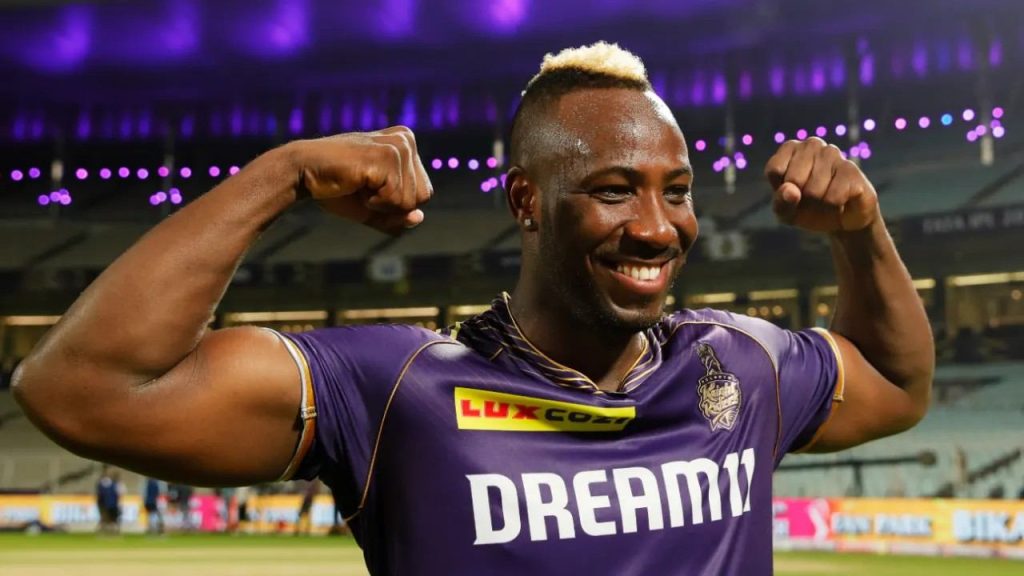
Highest Strike Rate in Men’s T20I and ODI Cricket
Cricket has changed dramatically over the years, with batters scoring faster and setting new records through explosive performances. Strike rate has become a crucial measure of batting performance, especially in limited-overs cricket, where every delivery counts. A powerful innings can turn a match around in just a few overs and leave fans amazed.
But who has the highest career batting strike rate in cricket? The answer depends on the format and the qualification criteria used. India’s Abhishek Sharma leads the men’s T20 International career strike-rate rankings, while West Indies star Andre Russell holds the highest career strike rate in men’s One Day Internationals among players who have batted in at least 10 innings.
Highest Career Strike Rate in Men’s T20 Internationals
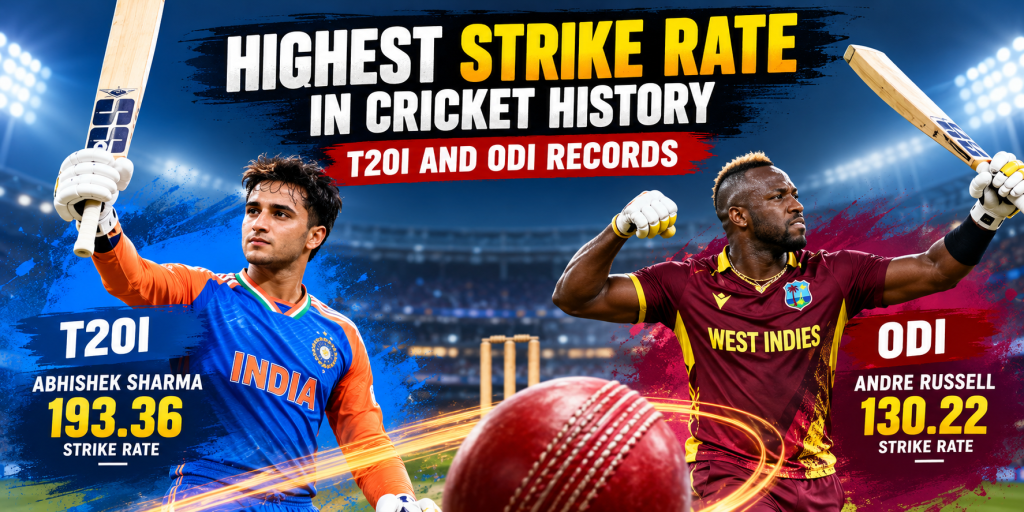
T20 International cricket gives aggressive batters opportunities to produce exceptional strike rates. Players often attack during the powerplay, target favourable bowling matchups and accelerate further during the final overs.
The following highlights five leading men’s T20I batters who have faced at least 500 balls. This higher threshold provides a more substantial sample for evaluating sustained scoring performance than a qualification of only 250 balls.
| Rank | Player | Team | Runs | Balls Faced | Strike Rate |
| 1 | Abhishek Sharma | India | 2,127 | 1,100 | 193.36 |
| 2 | Mohammad Ihsan | Spain | 903 | 518 | 174.32 |
| 3 | Karanbir Singh | Austria | 2,616 | 1,501 | 174.28 |
| 4 | Faisal Khan | Saudi Arabia | 1,794 | 1,033 | 173.67 |
| 5 | Finn Allen | New Zealand | 1,708 | 998 | 171.14 |
1. Abhishek Sharma
Abhishek Sharma leads the men’s T20I career strike-rate rankings with a strike rate of 193.36. The Indian left-handed batter combines attacking intent with an ability to find boundaries early in his innings.
His record includes 2,127 runs from 1,100 balls faced. This means he scores at a rate equivalent to approximately 1.93 runs per ball across his career. His aggressive approach is particularly effective in T20 cricket, where a fast start can put immediate pressure on the opposition and give the team momentum.
2. Mohammad Ihsan
Spain’s Mohammad Ihsan ranks among the leading qualified batters, with 903 runs from 518 balls and a strike rate of 174.32.
His record combines a high scoring rate with a substantial number of runs. Considering both figures gives readers a better understanding of his contribution than strike rate alone.
3. Karanbir Singh
Austria’s Karanbir Singh has scored 2,616 runs from 1,501 balls, recording a strike rate of 174.28.
His total is considerably larger than that of several batters with similarly high strike rates. This illustrates the importance of considering career volume alongside scoring speed when comparing players in international T20 cricket.
4. Faisal Khan
Saudi Arabia’s Faisal Khan has scored 1,794 runs from 1,033 balls at a strike rate of 173.67.
His figures demonstrate the attacking nature of modern T20 International cricket. Aggressive shot selection and the ability to find boundaries can help batters maintain high scoring rates across numerous innings.
5. Finn Allen
New Zealand’s Finn Allen completes this top five, with 1,708 runs from 998 balls and a strike rate of 171.14.
Allen is known for his attacking batting approach, particularly at the top of the order. A high career strike rate helps demonstrate how quickly he can score, although consistency, batting average and match conditions are also important when evaluating his overall performance.
What Is Strike Rate in Cricket?
Strike rate measures how quickly a batter scores runs or how frequently a bowler takes wickets. Its meaning depends on whether the statistic relates to batting or bowling.
Batting Strike Rate
A batter’s strike rate measures the number of runs scored per 100 balls faced. A higher figure generally indicates faster scoring.
Formula:
Batting Strike Rate = (Runs Scored ÷ Balls Faced) × 100
For example, if a batter scores 60 runs from 30 balls, the strike rate is 200.00. This means the player scores at a rate equivalent to 200 runs per 100 balls faced.
Bowling Strike Rate
A bowler’s strike rate measures the average number of legal deliveries required to take one wicket.
Formula:
Bowling Strike Rate = Balls Bowled ÷ Wickets Taken
A lower bowling strike rate is generally better because it means the bowler takes wickets more frequently.
This article focuses on batting strike rate, particularly in men’s T20 Internationals and One Day Internationals.
Highest Strike Rate in Men’s T20I and ODI Cricket
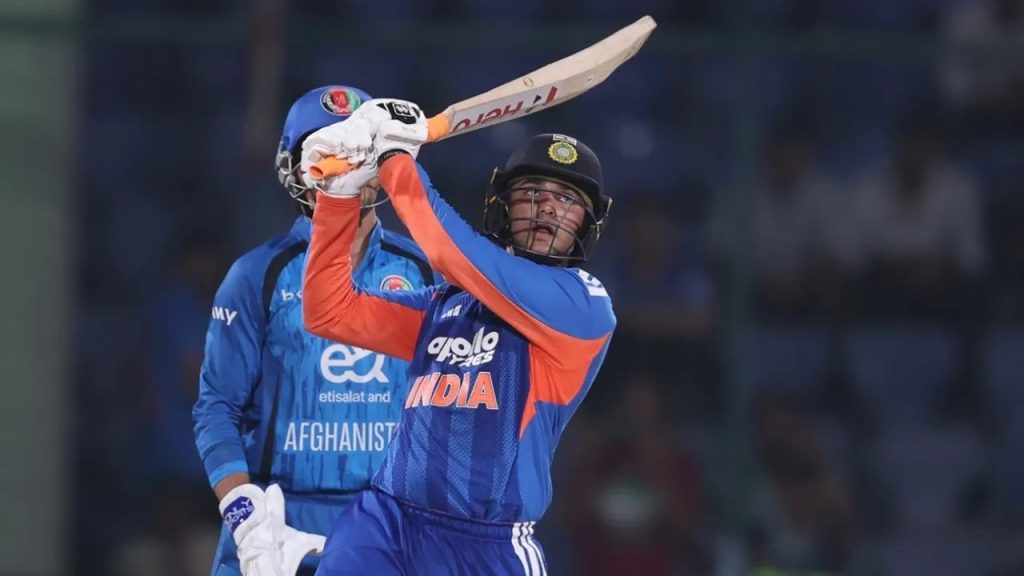
There is no single career strike-rate figure that applies equally to every format of cricket. Test matches, One Day Internationals and T20 Internationals have different scoring demands, and each format maintains separate statistical records.
In men’s T20 Internationals, Abhishek Sharma leads the rankings among batters who have faced at least 500 balls, with a strike rate of 193.36. In men’s ODIs, Andre Russell leads the career strike-rate list among players who have batted in at least 10 innings.
These records use different qualification criteria, so the figures should not be treated as directly comparable rankings. Match length, scoring conditions and the number of deliveries faced all influence how strike rates are interpreted.
Highest Career Strike Rate in Men’s ODI Cricket

One Day Internationals provide a different challenge from T20 cricket. Teams must manage 50 overs, preserve wickets and accelerate at the right time.
Andre Russell of the West Indies leads the men’s ODI career strike-rate table with 1,034 runs from 794 balls. Glenn Maxwell follows with 3,990 runs from 3,149 balls, while PJC Hoffmann appears among the leading players under the minimum-innings qualification.
| Rank | Player | Team | Runs | Balls Faced | Strike Rate |
| 1 | Andre Russell | West Indies | 1,034 | 794 | 130.23 |
| 2 | Glenn Maxwell | Australia | 3,990 | 3,149 | 126.71 |
| 3 | PJC Hoffmann | Australia | 85 | 68 | 125.00 |
| 4 | Mohammad Naveed | United Arab Emirates | 397 | 323 | 122.91 |
| 5 | Asif Ali | Pakistan | 382 | 314 | 121.66 |
Qualification: At least 10 innings. Strike rates in this table are calculated from the displayed runs and balls faced, rounded to two decimal places.
Andre Russell’s explosive batting has made him a major threat in the middle and lower order. Glenn Maxwell follows with a calculated strike rate of 126.71 and a considerably larger career run total than several other players in the table.
The list also illustrates the importance of qualification criteria. A minimum-innings requirement can include players who have faced relatively few deliveries compared with the leading batters. A higher minimum-ball or minimum-run threshold would produce a different ranking.
1. Andre Russell
Andre Russell leads the men’s ODI career strike-rate table with 1,034 runs from 794 balls at a calculated strike rate of 130.23. The West Indies all-rounder is known for his powerful hitting and ability to accelerate an innings in the middle and lower order.
His attacking style is suited to limited-overs cricket. Batters in these positions are often expected to score quickly, particularly when a team needs to increase its run rate towards the end of an innings.
2. Glenn Maxwell
Australia’s Glenn Maxwell has scored 3,990 runs from 3,149 balls, giving him a calculated strike rate of 126.71. His career run total provides a much larger statistical sample than several players appearing lower in the rankings.
Maxwell combines unconventional shot selection with power and the ability to score against different types of bowling. His record demonstrates how an aggressive approach can be sustained across an extensive international career.
3. PJC Hoffmann
PJC Hoffmann ranks third in the ODI career strike-rate table, with 85 runs from 68 balls at a strike rate of 125.00. His record includes 18 matches and 14 innings, meeting the table’s minimum qualification of 10 innings.
Although his career run total is relatively small, his entry meets the stated qualification rule. This demonstrates why the criteria used to rank players matter: meeting a minimum-innings requirement does not necessarily mean a batter has faced as many deliveries as the leading players.
4. Mohammad Naveed
Mohammad Naveed of the United Arab Emirates has scored 397 runs from 323 balls, recording a strike rate of 122.91. His position highlights the contribution of associate nations to ODI cricket and the variety of players represented in career statistical rankings.
A high strike rate can be especially valuable when a batter needs to accelerate an innings without consuming too many deliveries.
5. Asif Ali
Pakistan’s Asif Ali has scored 382 runs from 314 balls at a calculated strike rate of 121.66.
His aggressive batting style is suited to situations where a team needs quick runs. As with the other entries, his position should be interpreted alongside the qualification rule, number of innings and total runs. Strike rate is an important measure of scoring speed, but it does not independently measure a player’s overall contribution.
How Does Strike Rate Differ Across Cricket Formats?
Strike rate should always be interpreted in the context of the format.
| Format | Main Objective | How to Interpret Batting Strike Rate |
| Test cricket | Build innings and compete over multiple days | Patience, match situation and scoring speed all matter |
| ODI cricket | Balance scoring and wicket preservation across 50 overs | Acceleration and consistency are both important |
| T20 International | Score as many runs as possible in 20 overs | Aggressive scoring and boundary hitting are especially valuable |
A strike rate of 100 means something different in each format. In T20 cricket, it generally represents a relatively slow scoring pace. In a Test match, it can be extremely aggressive depending on the conditions and match situation.
There is also an important difference between career strike rate and innings strike rate. A player might score 30 runs from 10 balls at a strike rate of 300 in one innings. Another player might maintain a career strike rate of 160 across hundreds of balls. Both figures are impressive in their own context, but they measure different things.
Why Is a High Strike Rate Important in Cricket?
1. It Increases Scoring Pressure
Fast scoring forces bowlers to change their plans. Captains may adjust field placements, rotate bowlers or introduce defensive strategies to limit boundaries.
2. It Helps Teams Build Competitive Totals
In limited-overs cricket, a batter who scores quickly can help a team reach a challenging total without consuming too many deliveries. This becomes particularly important during the final overs.
3. It Supports Successful Run Chases
During a chase, the required run rate can rise quickly. A batter with an excellent strike rate can reduce the pressure on teammates and bring the target within reach.
4. It Changes the Value of Individual Innings
A quick 40 can sometimes be more valuable than a slower 60, depending on the target, wickets remaining and match conditions. Strike rate helps explain that difference, although it should never be considered in isolation.
Is Strike Rate the Only Measure of a Batter’s Quality?
No. Strike rate is important, but it does not tell the whole story.
A batter’s average, total runs, consistency, opposition quality and performance under pressure also matter. A player may maintain a high strike rate over a short career but struggle to reproduce it over a longer period.
Batting position is another factor. An opener may face difficult new-ball conditions and build a long innings. A finisher may face only a few deliveries and be expected to attack immediately. Their strike rates reflect different responsibilities.
For a more complete evaluation, compare strike rate with batting average, number of innings, total runs and match-winning contributions. This approach provides a fairer picture of a player’s overall impact.
Conclusion
Career batting strike rates vary by format and qualification criteria. In men’s T20 Internationals, Abhishek Sharma leads the ranking used in this article with a strike rate of 193.36 under the 500-ball qualification. In men’s ODIs, Andre Russell tops the career list under the 10-innings qualification, with a calculated strike rate of 130.23.
These records show how aggressive batting has become an essential part of modern limited-overs cricket. However, strike rate is most meaningful when considered alongside runs scored, consistency, career length and match impact. Clear qualification rules help readers understand what each statistical ranking represents.
Frequently Asked Questions
There is no single career strike-rate ranking covering every format and qualification rule. In men’s T20 Internationals, Abhishek Sharma leads the ranking used here with a strike rate of 193.36 among batters who have faced at least 500 balls. In men’s ODIs, Andre Russell leads the career list among players who have batted in at least 10 innings.
Abhishek Sharma of India leads the T20I ranking used in this article, with a strike rate of 193.36 based on 2,127 runs from 1,100 balls faced. The table uses a minimum qualification of 500 balls faced.
Andre Russell of the West Indies leads the ODI ranking used in this article, with 1,034 runs from 794 balls. Calculating the strike rate from these figures and rounding to two decimal places gives 130.23. The ranking uses a minimum qualification of 10 innings.
Divide the batter’s total runs by the number of balls faced and multiply the result by 100. For example, 75 runs from 50 balls produces a strike rate of 150.00.
A higher batting strike rate usually means faster scoring, which is valuable in limited-overs cricket. However, the best approach depends on the format, match situation, wickets remaining and the batter’s role. Strike rate should be considered alongside other performance statistics.